AI in Medicine

All Visitors (Last 90 Days)
1
Blogs
1

Expert-driven blogs tailored for physicians, medical students, and residents—bringing you the latest innovations, research, and practical applications of AI in modern medicine.

Abstract illustration of artificial intelligence intersecting with healthcare and society.
Humanity’s AI Test: Dario Amodei on Power, Risk, and Survival
dalle-2025-02-15-08-34-56-a-photorealistic-image-in-a-pinhole-camera-style-of-a-professional-medical-team-featuring-one-black-senior-physician-one-female-physician-one-black

FDA AI Update 2025 — 30-Second Clinician Brief 12/17/2025 

Bottom line: The FDA is no longer freezing AI tools in time. It now allows approved AI to update, adapt, and be monitored continuously—and this affects what shows up in your clinic.

What You Actually Need to Know

1. AI tools can now update after approval
Thanks to new FDA rules (PCCPs), some AI tools will change over time without re-approval.
Ask: “How are updates tracked and communicated?”

2. FDA now expects ongoing monitoring
Manufacturers must watch for accuracy drift and bias once AI is deployed.
Expect: clearer disclosures about training data and limitations.

3. Patients will ask about AI therapy apps
The FDA is actively building rules for generative AI in mental health.
Reality: Few are approved for independent therapy yet—but questions are coming.

4. Radiology still dominates AI approvals
~80% of FDA-cleared AI tools are imaging-based.
More specialties will follow as approvals accelerate.

5. The FDA is using AI to regulate AI
The agency is deploying agentic AI internally to speed reviews.
Net effect: faster access to new tools.

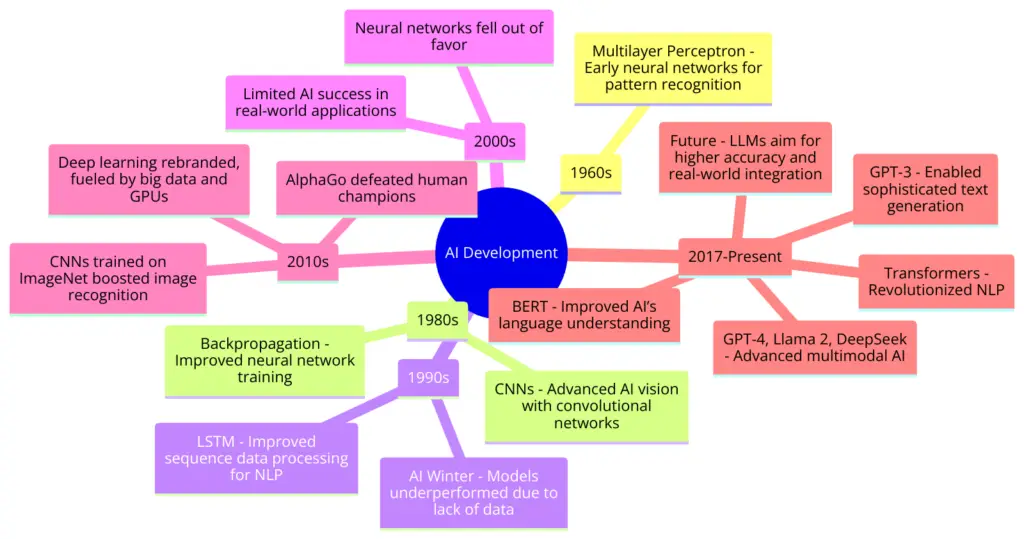
LLMs Evolution Over Time

AI Technology Summary Table

Quick Reference: AI Technology Summary

Technology Simple Definition Real-World Example
Artificial Intelligence (AI) Machines that imitate human intelligence and actions Siri or Alexa
Machine Learning (ML) Computers learn patterns from data automatically Netflix recommendations
Deep Learning (DL) Advanced ML using neural networks to handle complex data Facial recognition
Natural Language Processing (NLP) Computers understanding and interacting with human language Google Translate, Chatbots
Multilayer Perceptron (MLP) Basic neural network used for general predictions Disease risk prediction
Convolutional Neural Networks (CNNs) Neural network designed for image analysis Medical imaging (X-ray analysis)
Transformers Neural networks specialized in language understanding ChatGPT, language translation